
Mednosis LogoMednosis
Jul 6, 2026

Clinical Innovation: Week of July 06, 2026

8 research items

Clinical Innovation: Week of July 06, 2026
Why high scores do not mean application readiness for health AI
Nature Medicine - AI SectionExploratory2 min read

Why Ace Test Scores Don't Make Medical AI Safe

Key Takeaway:

High test scores do not guarantee that medical artificial intelligence is safe or reliable enough for real-world patient care and clinical decision-making.

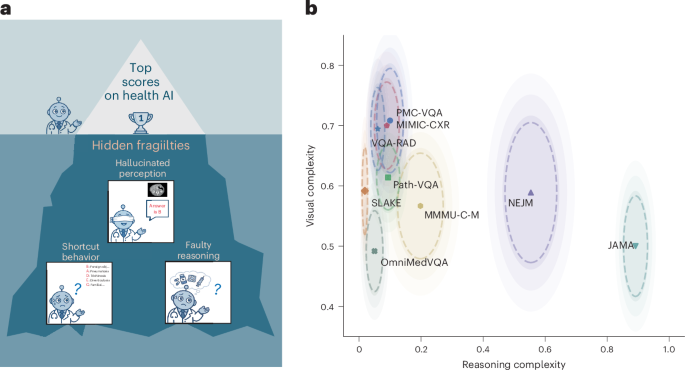
Artificial intelligence programs are scoring incredibly high on medical exams, but new research shows these high scores are highly misleading. When scientists put these AI models through rigorous stress tests, they discovered major weaknesses. The AI programs often rely on shortcuts to get the right answer, struggle to accurately connect images to text, and even make up fake logical steps to explain their decisions. This means that while the AI looks smart on paper, it is still too fragile and unreliable to be trusted with real patient care or to help doctors make critical medical decisions. More rigorous testing is needed before these tools are ready for the public.

What this means for you

While health AI models score well on tests, they can still make hidden errors and invent logical steps. Do not rely on AI for medical decisions yet; it is not ready.

Citation:

Nature Medicine - AI Section, 2026. DOI: s41591-026-04500-9 Read article →
Safety Alert
Human embryonic stem cell-derived dopaminergic cells for Parkinson’s disease: a phase 1/2 open-label trial
Nature Medicine - AI SectionExploratory2 min read

Stem Cell Transplant for Parkinson's Passes First Major Safety Test

Key Takeaway:

A new stem cell therapy for Parkinson's disease proved safe over 12 months, though the required immune-suppressing drugs carry notable patient risks.

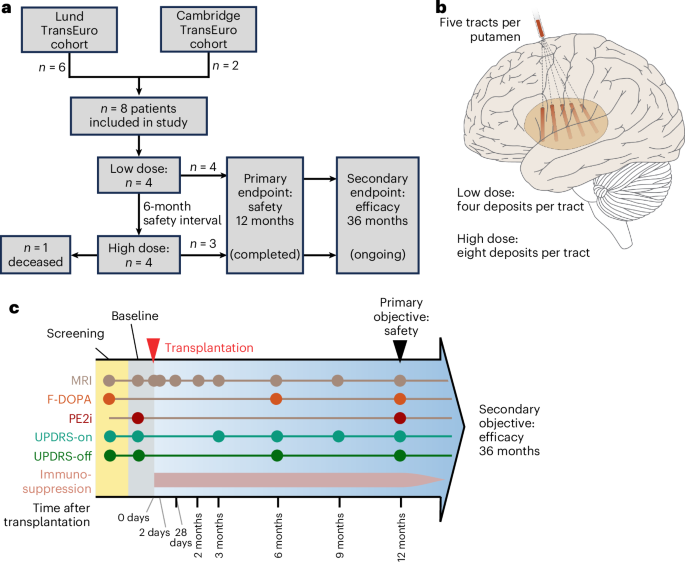
Parkinson's disease destroys the brain cells that produce dopamine, a chemical vital for controlling movement. In a new early-stage clinical trial, scientists tested a promising treatment that transplants healthy, lab-grown stem cells into the brain to replace these lost cells. Over one year, the transplant proved highly safe, causing no tumors or dangerous involuntary movements. However, patients did experience side effects from the strong immune-suppressing drugs needed to keep their bodies from rejecting the new cells. While this treatment is still years away from general availability, it is a major step forward in developing therapies that could eventually repair the brain.

What this means for you

An early-stage study shows a new stem cell transplant is safe for Parkinson's, but the necessary immune-suppressing drugs pose risks. Do not alter your current treatment plan.

Citation:

Nature Medicine - AI Section, 2026. DOI: s41591-026-04525-0 Read article →

Nature Medicine - AI SectionExploratory3 min read

Why Your Medical Consent Forms Need a Digital Upgrade

Key Takeaway:

Modernizing medical consent by establishing explicit patient data rights is essential to protect privacy and maintain trust as healthcare increasingly relies on artificial intelligence.

When you sign a consent form at the doctor's office, it usually covers the risks of a treatment or test. However, these traditional forms do not protect your digital information in the age of artificial intelligence. This study explains that our current medical system is missing a key piece: clear data rights. As computer programs are trained on patient records to develop new medical tools, patients need to know who owns their data, where it goes, and how it is used. The researchers argue that updating consent to include digital data rights will help protect your privacy and ensure you have a say in how your personal health information is shared.

What this means for you

This article discusses how medical consent needs to change to protect your digital health information. It does not change your current medical care, but highlights your future rights.

Citation:

Nature Medicine - AI Section, 2026. DOI: s41591-026-04506-3 Read article →

Safety Alert
Polypill for heart failure with reduced ejection fraction: the POLY-HF randomized trial
Nature Medicine - AI SectionPromising2 min read

Three-in-One Daily Pill Shows Promise for Heart Failure Patients

Key Takeaway:

A single daily combination pill containing three heart medications significantly improved heart pumping function and reduced emergency care visits for heart failure patients within six months.

Researchers studied a new "polypill" that combines three common heart medications—metoprolol, spironolactone, and empagliflozin—into a single daily dose for people with heart failure. Usually, patients must take these as separate pills, which can be hard to manage. The study found that after six months, patients taking this single combination pill had better heart-pumping strength and fewer emergency room visits or hospital stays compared to those receiving standard care. This is important because simplifying a complicated medication routine into one pill makes it much easier for patients to take their life-saving medicine consistently, ultimately keeping them healthier and out of the hospital.

What this means for you

A new 3-in-1 daily heart pill helped patients stay out of the hospital in a six-month study. Do not alter your current heart medications without consulting your doctor.

Citation:

Nature Medicine - AI Section, 2026. DOI: s41591-026-04504-5 Read article →

Google News - AI in HealthcarePromising2 min read

AI 'Digital Twin' Technology Aims to Improve Between-Visit Diabetes Care

Key Takeaway:

A new AI-powered 'digital twin' system simulates patient data to help doctors provide personalized, continuous diabetes care and adjust treatments between regular office visits.

Managing diabetes usually means waiting months between doctor visits to make treatment changes. To bridge this gap, researchers have developed an AI-powered 'digital twin' system. This technology creates a virtual mirror of a patient's unique metabolism using their personal health data. The AI can then predict how the patient will respond to different foods, activities, and insulin doses. Crucially, real doctors remain in control, reviewing the AI's suggestions before any changes are made. This approach aims to make diabetes care safer, more continuous, and highly personalized, helping patients stay healthy and avoid dangerous blood sugar swings between their regular clinic appointments.

What this means for you

Researchers are developing an AI 'digital twin' to help doctors monitor and adjust your diabetes care between appointments. This technology is still in development; do not alter your current treatment plan.

Citation:

Google News - AI in Healthcare, 2026. Read article →

Safety Alert
Claude Science is Anthropic’s newest flagship product
MIT Technology Review - AIExploratory2 min read

Anthropic Launches Claude Science to Help Run Scientific Research

Key Takeaway:

Anthropic has announced Claude Science, an autonomous AI tool designed to help researchers and biotech companies accelerate scientific discovery through high-level instructions.

Anthropic has announced a new artificial intelligence tool called Claude Science. Just like some AI tools help software engineers write code, this new tool is designed to help scientists, drug makers, and biotechnology researchers with their work. It can perform research tasks on its own after being given simple, high-level instructions. While we do not have specific test results or data on how well it works yet, this technology could eventually help researchers discover new medicines and scientific breakthroughs much faster than they can today.

What this means for you

A new AI tool called Claude Science has been announced to help scientists do research. It is not yet ready to change your personal medical care.

Citation:

MIT Technology Review - AI, 2026. Read article →

Guideline Update
ArXiv - AI in Healthcare (cs.AI + q-bio)Exploratory2 min read

How Do We Test AI That Is Smarter Than Humans?

Key Takeaway:

As artificial intelligence surpasses human capabilities, a new self-evaluating rating system allows AI models to test and score each other without needing human-designed exams.

When artificial intelligence becomes smarter than humans, we can no longer write tests to measure how smart or safe it is because the answers are beyond our own understanding. To solve this, researchers designed a new system where AI models create difficult challenges for one another. By grading each other's performance, the systems generate a continuous, self-scaling leaderboard. This ensures we can still measure and monitor highly advanced AI systems even after they surpass human capabilities. While this is early-stage research, it is a vital step toward making sure future super-smart technologies remain reliable and safe for society.

What this means for you

Researchers are designing new ways for super-smart AI systems to test and grade each other. This is early stage research and does not impact your medical care or treatments today.

Citation:

ArXiv, 2026. arXiv: 2607.07040 Read article →

Guideline Update
ArXiv - Quantitative BiologyExploratory3 min read

How a Single Antibody Shot Could Protect Whole Families From RSV

Key Takeaway:

A new mathematical model shows that expanding Nirsevimab antibody protection to infants, including those born off-season, significantly reduces RSV infections across all age groups.

Respiratory syncytial virus, or RSV, is a common virus that can cause severe lung infections in babies. Researchers used a advanced computer model of the Italian population to study how a long-acting protective shot called Nirsevimab affects the spread of the virus. They found that giving this antibody shot to more babies—including those born outside of the typical winter RSV season—not only protects the infants themselves but also creates a shield that reduces infections in older children and adults. While the shot alone cannot completely wipe out the virus, these findings show that widespread use could significantly ease the yearly winter burden on families and hospitals.

What this means for you

Scientists used computer modeling to show that giving babies a protective antibody shot against RSV helps prevent infections in both infants and older family members. This research is still in the planning stages.

Citation:

ArXiv, 2026. arXiv: 2607.08344 Read article →

New to reading medical AI research? Learn how to interpret these studies →