
Mednosis LogoMednosis
Jun 19, 2026

Clinical Innovation: Week of June 19, 2026

6 research items

Clinical Innovation: Week of June 19, 2026
Guideline Update
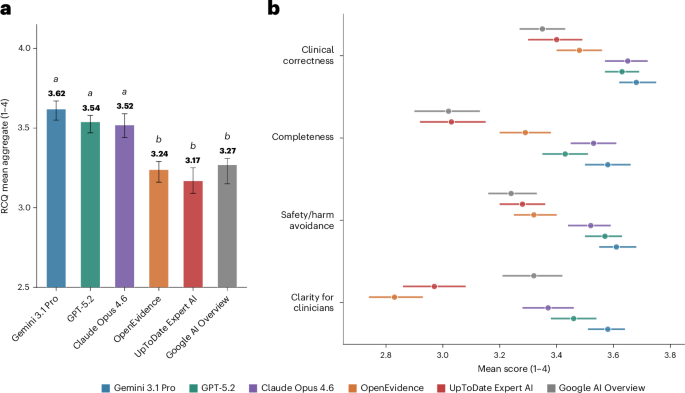
General-purpose chatbots outperform clinical AI tools on physicians’ real-world questions
Nature Medicine - AI SectionExploratory2 min read

General AI Beats Specialized Medical Tools at Answering Doctors' Questions

Key Takeaway:

General-purpose AI models outperform specialized medical AI tools when answering real clinical questions, suggesting doctors should use specialized tools with caution.

As artificial intelligence enters healthcare, many companies are building specialized AI tools designed specifically for doctors. However, a new study tested these specialized medical tools against everyday, general-purpose AI models using real questions from physicians. Surprisingly, the general-purpose AI models performed much better. In fact, the specialized medical AI tools did no better than a standard Google search AI summary. This matters to regular people because it shows that 'specialized' medical technology is not always superior, and we must carefully test these tools before they are used to help guide patient care.

What this means for you

New research shows general-purpose AI tools actually beat specialized medical AI at answering doctors' questions. Patients should always rely on their human doctor for personalized medical advice.

Citation:

Nature Medicine - AI Section, 2026. DOI: s41591-026-04457-9 Read article →

Guideline Update
Nature Medicine - AI SectionPromising2 min read

Could the Shingles Vaccine Be a Secret Weapon Against Dementia?

Key Takeaway:

Strong observational evidence suggests shingles vaccination might prevent dementia, prompting international experts to call for immediate, large-scale clinical trials to confirm these findings.

Researchers are highlighting a highly promising connection: people who get the live-attenuated shingles vaccine seem to have a lower risk of developing dementia. While this link is based on looking back at real-world patient data, experts from the U.S. National Institutes of Health and international panels agree the evidence is incredibly strong. To prove if the vaccine actually causes this protective effect, scientists are urgently calling for large-scale clinical trials. For now, the vaccine is only approved to prevent shingles, but this research could eventually open up a simple, existing way to help protect our brains as we age.

What this means for you

While shingles vaccines show a strong link to lower dementia risk in observational studies, please do not seek the vaccine solely for dementia prevention until clinical trials confirm these benefits.

Citation:

Nature Medicine - AI Section, 2026. DOI: s41591-026-04474-8 Read article →

Engineered heart muscle passes early clinical milestone
Nature Medicine - AI SectionExploratory2 min read

Lab-Grown Heart Muscle Patches Pass First Major Safety Test

Key Takeaway:

Lab-grown heart muscle grafts show early promise for treating severe heart failure, offering a potential new treatment option within the next five to ten years.

Researchers have successfully tested a new way to help people with severe, hard-to-treat heart failure. When a person has heart failure, their heart muscle becomes too weak to pump blood effectively. In this study, scientists used stem cells to grow living patches of human heart muscle in a lab. They then grafted these patches onto the damaged hearts of patients. The early results are highly promising, showing that the treatment is safe and helps support the heart's pumping chamber. While this therapy is still in its early testing phases and is not yet widely available, it represents a major step toward using lab-grown tissues to repair failing organs without needing a full heart transplant.

What this means for you

Scientists successfully tested lab-grown heart muscle patches in patients with severe heart failure. This early-stage therapy is not yet widely available; please do not alter your current heart treatment plan.

Citation:

Nature Medicine - AI Section, 2026. Read article →

Guideline Update
ArXiv - Quantitative BiologyExploratory2 min read

New AI Tool Designs Ring-Shaped Molecules to Target Hard-to-Reach Diseases

Key Takeaway:

A new AI model called PepALD designs complex macrocyclic peptide drugs more effectively in simulations, which could eventually speed up the discovery of hard-to-reach intracellular therapies.

Scientists have developed a new artificial intelligence tool called PepALD to help design a special class of drugs known as macrocyclic peptides. These are ring-shaped molecules that are excellent at entering cells to treat complex diseases, but they are incredibly difficult to design by hand. Traditional computer models often treat the building blocks of these molecules like simple text, missing important chemical details. PepALD solves this by using advanced AI to understand the actual chemistry of the building blocks, predicting how they will fold and link together. In computer tests, PepALD designed high-quality drug candidates much faster than older methods, marking an exciting first step toward faster drug discovery.

What this means for you

Scientists created an AI tool to design specialized, ring-shaped drug molecules. This technology is in the early research phase and is not yet available for patients; current medical treatments remain unchanged.

Citation:

ArXiv, 2026. arXiv: 2606.14510 Read article →

A startup claims it broke through a bottleneck that’s holding back LLMs
MIT Technology Review - AIExploratory2 min read

Startup Claims Breakthrough in Making AI Models Run Faster

Key Takeaway:

A startup claims to have solved a decade-old mathematical bottleneck, which could eventually make artificial intelligence models faster and much cheaper to run.

A new artificial intelligence startup called Subquadratic claims it has solved a major mathematical problem that has slowed down computer language models for nearly ten years. When the company first made the announcement, many experts were skeptical because there were very few details. Now, the company has started sharing evidence to back up its claims. If this technology works, it could make artificial intelligence much faster and cheaper to run. For regular people, this could eventually lead to smarter, quicker AI assistants and tools, though the technology is still in its very early stages and needs to be tested by other scientists first.

What this means for you

A tech company claims to have made a breakthrough that could make future AI tools faster. This is early research and does not change your current medical care.

Citation:

MIT Technology Review - AI, 2026. Read article →

Are Physicians Losing Skills Due To AI? What Is Cognitive Offloading?
The Medical FuturistExploratory2 min read

Could Relying on AI Cause Doctors to Lose Their Skills?

Key Takeaway:

As doctors increasingly delegate mental tasks to artificial intelligence, there is a growing concern that clinicians might lose critical diagnostic skills over time.

This article explores 'cognitive offloading,' which is what happens when doctors hand over mental tasks to artificial intelligence. Today, physicians use AI for many jobs, like sorting patients based on how sick they are. While this technology makes hospital work faster, experts worry that doctors might slowly lose their own medical skills if they let computers do too much of the thinking. This matters to everyday people because we need to ensure that even in an AI-driven world, our human doctors remain highly skilled, sharp, and capable of making critical decisions on their own.

What this means for you

While AI helps doctors manage paperwork and patient sorting, patients should know this early research cautions that doctors must maintain their hands-on medical skills.

Citation:

The Medical Futurist, 2026. Read article →

New to reading medical AI research? Learn how to interpret these studies →