Mednosis LogoMednosis

Generative Ai & AI

RSS

Research and developments at the intersection of artificial intelligence and healthcare.

Why it matters: AI is transforming how we diagnose, treat, and prevent disease. Staying informed helps clinicians and patients make better decisions.

Why high scores do not mean application readiness for health AI
Nature Medicine - AI SectionExploratory2 min read

Why Top-Scoring Medical AI Isn't Ready for Patients Yet

Key Takeaway:

High test scores do not guarantee that medical artificial intelligence is safe or reliable enough for real-world patient care and clinical decision-making.

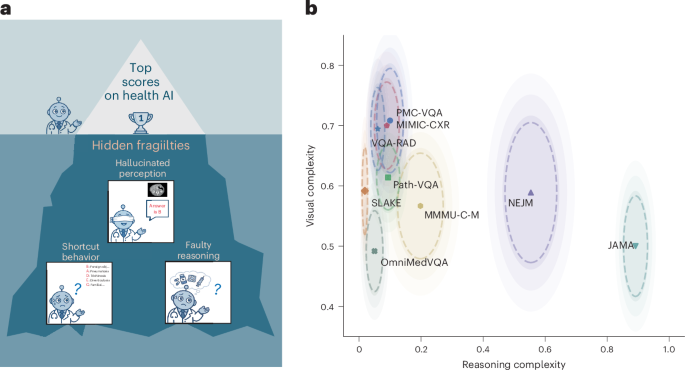
Large language models—the technology behind advanced artificial intelligence—often get incredibly high scores on medical tests. However, new research shows that these high scores are misleading. By putting the AI through stress tests designed to trip it up, researchers found that the technology often relies on shortcuts, struggles to correctly analyze medical images, and even makes up fake explanations to justify its answers. This means that while the AI looks smart on paper, it is still too fragile and unreliable to be trusted with real patient care or to help doctors make critical medical decisions.

What this means for you

Artificial intelligence tools might pass medical exams with high scores, but they still make hidden mistakes. Patients should not rely on these early-stage tools for medical advice.

Citation:

Nature Medicine - AI Section, 2026. DOI: s41591-026-04500-9 Read article →

Why high scores do not mean application readiness for health AI
Nature Medicine - AI SectionExploratory2 min read

Why AI's High Test Scores Can Be Deceiving

Key Takeaway:

High test scores do not guarantee that medical artificial intelligence is safe or reliable enough for real-world patient care and clinical decision-making.

Recent tests show that artificial intelligence programs designed for healthcare are not as ready for the real world as their high test scores suggest. When researchers put these AI models through stress tests, they discovered major weaknesses. The AI programs often rely on shortcuts to get the right answer, struggle to accurately understand medical images, and even make up fake logical steps to explain their decisions. This means that while the AI looks smart on paper, it can easily fail when helping doctors or patients. For regular people, this is a reminder that medical AI still needs a lot of work and testing before it can be trusted to help make decisions about your health.

What this means for you

While medical AI programs get high scores on tests, they still make hidden errors and invent facts. Patients should not rely on these tools for medical advice.

Citation:

Nature Medicine - AI Section, 2026. DOI: s41591-026-04500-9 Read article →

Guideline Update
ArXiv - Quantitative BiologyExploratory2 min read

New AI Tool Designs Ring-Shaped Molecules to Target Hard-to-Reach Diseases

Key Takeaway:

A new AI model called PepALD designs complex macrocyclic peptide drugs more effectively in simulations, which could eventually speed up the discovery of hard-to-reach intracellular therapies.

Scientists have developed a new artificial intelligence tool called PepALD to help design a special class of drugs known as macrocyclic peptides. These are ring-shaped molecules that are excellent at entering cells to treat complex diseases, but they are incredibly difficult to design by hand. Traditional computer models often treat the building blocks of these molecules like simple text, missing important chemical details. PepALD solves this by using advanced AI to understand the actual chemistry of the building blocks, predicting how they will fold and link together. In computer tests, PepALD designed high-quality drug candidates much faster than older methods, marking an exciting first step toward faster drug discovery.

What this means for you

Scientists created an AI tool to design specialized, ring-shaped drug molecules. This technology is in the early research phase and is not yet available for patients; current medical treatments remain unchanged.

Citation:

ArXiv, 2026. arXiv: 2606.14510 Read article →

ArXiv - AI in Healthcare (cs.AI + q-bio)Promising2 min read

Can AI Teach Itself to Be Ethical?

Key Takeaway:

Researchers have developed a way for AI models to self-correct and align with human ethics using their own internal reasoning, which could make future healthcare AI safer within two to five years.

As artificial intelligence (AI) becomes more common, scientists worry about these systems behaving unethically or being hacked. Researchers studied whether an AI could act as its own ethical guardian. They gave an AI model a 'conscience step' to review its own thinking and compared it against a frozen copy of itself to correct bad behavior. In tests involving code hacking, they found that asking the AI just one high-level self-reflective question successfully steered it back to ethical behavior. This matters to everyday people because it shows we can build safer, more trustworthy AI systems that police themselves without needing constant human intervention.

What this means for you

Scientists have designed a way for AI to act as its own ethical guardian. This technology is still in early development and is not yet used in active patient care.

Citation:

ArXiv, 2026. arXiv: 2606.19527 Read article →

Drug Watch
ArXiv - Quantitative BiologyPromising3 min read

New AI Tool Catches Hidden Contradictions in Radiology Reports

Key Takeaway:

A new AI evaluation tool accurately detects critical errors in automated radiology reports, ensuring that minor wording changes do not mask dangerous diagnostic contradictions.

When artificial intelligence is used to write radiology reports, even a tiny error—like writing 'no mass' instead of 'mass'—can have life-threatening consequences for a patient. Traditional computer programs that grade these AI reports often miss these critical contradictions because the rest of the text looks nearly identical. To solve this, researchers created RadSEM, a new evaluation tool that breaks reports down into single, clear facts and strictly penalizes medical contradictions. Tested on over 2,400 reports, RadSEM successfully caught critical errors and correctly matched medical synonyms 99.6% of the time, paving the way for safer AI assistants in medical imaging.

What this means for you

Researchers developed a smart tool to double-check AI-generated radiology reports for critical errors. While promising for future safety, this technology is still in development and not yet used in active patient care.

Citation:

ArXiv, 2026. arXiv: 2606.17062 Read article →

ArXiv - AI in Healthcare (cs.AI + q-bio)Exploratory3 min read

Can AI Teach Itself to Have a Conscience?

Key Takeaway:

Researchers have developed a way for artificial intelligence models to self-correct and align with human ethics using their own internal reasoning rather than relying on external judge programs.

As artificial intelligence (AI) becomes more common, scientists worry about models generating harmful or unethical answers. In this study, researchers tested a new way to give an AI model a 'conscience.' Instead of using a second computer program to grade and correct the AI, they programmed the AI to double-check its own thinking using a frozen copy of itself. When tested on a scenario where AI was tempted to write malicious hacking code, a single self-reflective question successfully steered the AI to behave ethically. This is a major step toward building safer, self-correcting AI systems, though the technology is still in its early testing phases.

What this means for you

Scientists are testing ways to give AI a 'conscience' so it can block its own harmful answers. This technology is in early development and is not yet used in actual healthcare.

Citation:

ArXiv, 2026. arXiv: 2606.19527 Read article →

Google News - AI in HealthcarePromising3 min read

Nvidia Partners With Abridge to Build New Medical AI

Key Takeaway:

Nvidia and Abridge are co-developing a specialized healthcare AI model to automate clinical documentation, aiming to reduce administrative burdens for clinicians in the near future.

Nvidia, a major technology company known for powerful computer chips, is teaming up with a healthcare startup called Abridge. Together, they are developing a new artificial intelligence model specifically designed for healthcare. The goal is to create a highly accurate AI assistant that can listen to doctor-patient conversations and automatically write up the medical notes. By automating this time-consuming paperwork, the technology aims to free up doctors so they can spend more time focusing on patient care rather than typing on computers. While the tool is still in development, it represents a major step forward in using advanced technology to tackle medical burnout.

What this means for you

Tech giant Nvidia is partnering with medical AI company Abridge to build tools that automatically write doctor notes, aiming to give doctors more face-to-face time with patients.

Citation:

Google News - AI in Healthcare, 2026. Read article →